
Juan Sebastián Parada
Research Coordinator for Economic and Social Studies Related to Quality Infrastructure
ONAC
Diego Alejandro Contreras López
Expert Research Professional for Economic and Social Studies Related to Quality Infrastructure
ONAC
Daniela Lucía Patiño Mendoza
Research Professional for Economic and Social Studies Related to Quality Infrastructure
ONAC
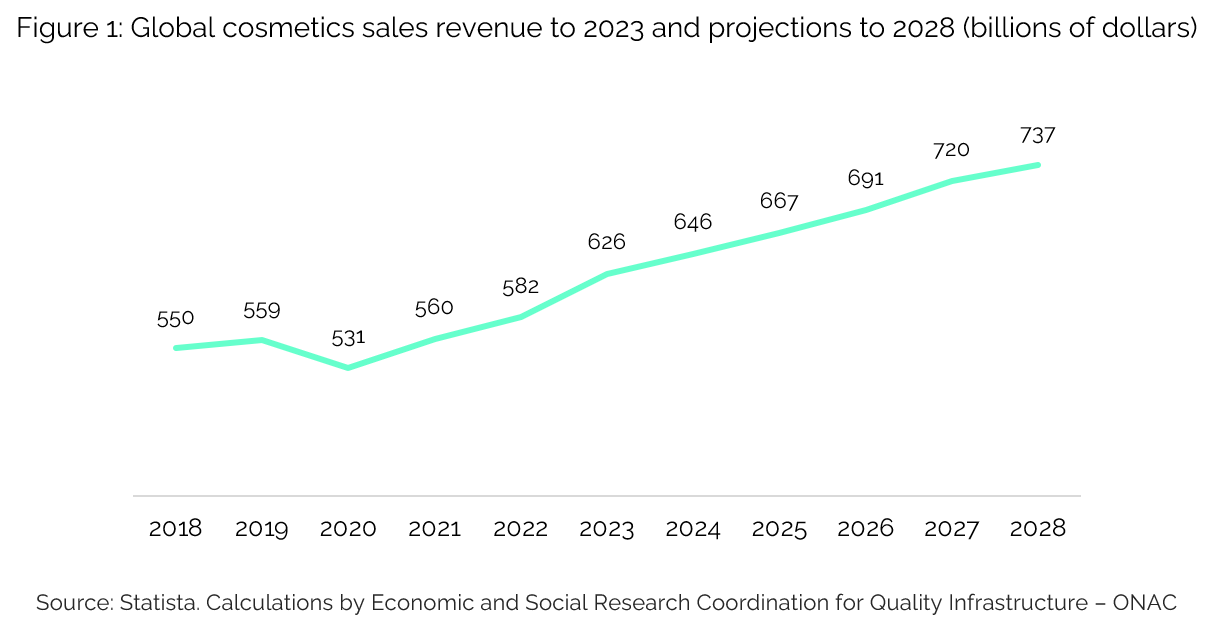
In recent years, the popularity of cosmetic products has intensified, which is reflected in growing demand and, consequently, an increase in the total profits generated by the sector globally. In 2023, the industry recorded a total profit value of more than US$625.6 billion and is expected to reach US$646.13 billion in 2024. It is also important to highlight that in the last 5 years, the beauty industry has grown by 12%, despite the pandemic and the complicated international scenario.[1] This situation has allowed the cosmetics market to evolve significantly, and the sector is positioned as one of the most relevant in the global economy.
The evolution of sales of the sector globally shows a growing behavior (Figure 1). Growth projections indicate that the sector will continue to grow in the coming years, which indicates its strength and future relevance in the market.
The share of each of the cosmetic product categories in the global market[2] is shown in Figure 2.

Focusing on the manufacturing process of cosmetic products, these must be subjected to pre-clinical tests to guarantee their safety concerning the environment and human health. The tests are covered under GLP-OECD principles and can be physicochemical, microbiological or in vitro tests, but never in humans[3]. Test results performed through GLP principles and guidelines are guaranteed to be consistent and conform to international standards, which facilitates mutual acceptance of data between OECD member countries and other countries following these guidelines, which supports exports and acceptance of products in different countries.
On the other hand, the importance of accreditation in the value chain of cosmetic products is determined by the compliance with requirements for the entry of products into international markets and the increasing consumer demand for quality and sustainable cosmetics[4]. In this context, accredited certification becomes relevant by encouraging producers to align themselves in continuous improvement processes and to communicate (through their certifications) a message of corporate responsibility to conscious consumers. Accreditation acts as a seal of assurance that the cosmetic products they use meet high standards of quality, safety and sustainability.

Thus, accreditation in the cosmetics industry serves as a guarantee for consumers and simultaneously facilitates and favors the export capacity of producers to the extent that it ensures that cosmetics meet rigorous standards of quality, safety and efficacy. In this sense, it is much more than a requirement of the regulator; it is an essential tool that boosts quality, safety and confidence in the products.
As the industry evolves and faces new challenges, both the production of chemicals for the sector under OECD GLP principles and accreditation will continue to be a fundamental pillar in ensuring that cosmetics are both innovative and safe, offering products of the highest quality and reliability. It is therefore crucial that the cosmetics industry encourages the adoption of OECD GLP practices and accreditation and maintains a proactive focus on continuous improvement of quality standards to ensure that cosmetic products continue to meet consumer expectations and the demands of the international marketplace.[5]
[1] Statista (2024) Beauty and personal care – Worldwide. Retrieved from: https://www.statista.com/outlook/cmo/beauty-personal-care/worldwide#revenue
[2] Fortune Business Insights (2024). Cosmetics Market Size, Share & Industry Analysis, By Category (Hair Care, Skin Care, Makeup, and Others), By Gender (Men and Women), By Distribution Channel (Specialty Stores, Hypermarkets/Supermarkets, Online Channels, and Others), and Regional Forecasts, 2024-2032. Retrieved from: https://www.fortunebusinessinsights.com/cosmetics-market-102614
[3] SAFE+ (s.f.) Buenas Prácticas de Laboratorio de la OCDE. Guía de implementación de los principios en entidades de ensayo. Retrieved from: https://www.unido.org/sites/default/files/files/2019-02/Buenas_Pr%C3%A1cticas_de_Laboratorio_de_la_OCDE.pdf
[4] Provital (s.f.) The cosmetic certification: why it´s key in a market led by consumers seeking transparency. Retrieved from: https://blog.weareprovital.com/why-to-certificate-cosmetics/
[5] For further information, see ONAC’s recent investigation about cosmetics and accreditation: Certifications in the skin: how accreditation contributes to security in the cosmetics industry.
Categories: IAF Members' news
 IAF Outlook