
Ann-Sara Ramkissoon
University of Florence
Ulrich Harmes-Liedtke
Mesopartner
Introduction
In the last edition of the IAF Outlook, we introduced the Global Accreditation Experience Index (GAEI) as a new indicator of an economy’s accreditation capability. Since then, we have refined our methodology and calculated the index for 120 countries from 2000 to 2024. In this edition, we explain the methodology and present the accreditation experience of selected economies in our dataset from 2000 to 2024.
Methodology
The GAEI was designed to quantify a country’s accreditation experience over time. It is calculated as follows:

- We first calculate the years of existence of accreditation scopes by taking the difference between a given year and the year the accreditation scope was introduced (see the purple bar in Figure 1).
- Next we compute an economy’s experience in each accreditation scope by subtracting the year the country signed the scope from the year the scope was introduced (see the orange bar in Figure 1).
- To ensure that each scope contributes proportionally to the index based on its duration, we calculate the weight of each scope by dividing the years of existence of that scope by the total years of existence of all scopes present at a given time.
- The GAEI for an economy at a given time is then calculated by summing the contributions of each scope, where each scope’s contribution is weighted by both its duration and the country’s experience in that scope.
Mathematically, the GAEI for a given year, t, for economy i is given by the equation:
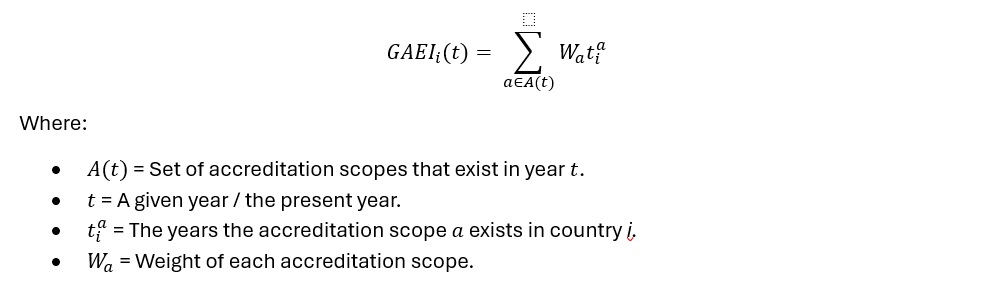

Figure 1: Timeline of the years of existence of a given accreditation scope and the experience of a given country in that scope
The index gives more weight to countries that signed accreditation scopes earlier, which aligns with the idea that longer participation contributes to maturity or experience. The formula does not change, but the values evolve dynamically as the dataset expands over time. This dynamic structure prevents early adopters from having disproportionately high scores indefinitely.
As time progresses and new scopes are introduced, the index evolves to reflect these changes. The total years of existence for all scopes and the individual years of experience for countries are recalculated each year, making the index a dynamic measure of country’s experience in accreditation. As a result, the index accounts for the growth in the number of scopes.
By using this approach, we obtain a comprehensive experience index that not only quantifies a country’s involvement but also adjusts over time as new scopes are introduced. The flexibility of the model allows it to reflect both the passage of time and the increased number of agreements in force.
There are three versions of the index, each incorporating an increasing number of accreditation scopes, as outlined in Table 1.

Figure 2 presents the GAEI Version 3 for selected economies from 2000 to 2024, along with the highest attainable score each year (MAX). Between 2000 and 2005, China (CHN), Germany (DEU), the United States (USA), and South Africa (ZAF) consistently reached the maximum scores, indicating early and strong accreditation capabilities. However, as more accreditation scopes were introduced over time, these countries, while still among the leaders, no longer maintained the maximum score. India (IND) and South Korea (KOR) show a notable dynamic. Although South Korea began developing its accreditation system earlier, India quickly accelerated its progress—surpassing South Korea around 2012—largely due to signing onto more accreditation scopes. Colombia (COL) and Kenya (KEN) began their accreditation journeys later relative to other economies but demonstrated rapid development, particularly from 2010 onward. Ethiopia (ETH), by contrast, is at the early stages of its accreditation development. While progress has been slower, the upward trend indicates a steady and emerging engagement in global accreditation systems. Vietnam (VNM) shows consistent and progressive growth, maintaining a strong upward trajectory similar to other developing accreditation systems.

Figure 2: GAEI for selected countries from 2000-2024
Conclusions
The GAEI is the first longitudinal dataset on accreditation. While it was developed primarily for economic impact studies, even without such analysis, the data shows that developing economies are increasingly engaging in international accreditation, with some surpassing their counterparts with longer-established systems. Country context is important, as accreditation scopes reflect national priorities. Over time, the gap between countries has narrowed as latecomers catch up. While several private certification schemes have emerged in recent years, they are still in early stages and lack data on signatories. However, the GAEI is dynamic and can incorporate these schemes as data becomes available.
Categories: Stakeholder News
 IAF Outlook